

Congratulations. Your audit trail worked.
You can see the input, the model version, the retrieved context, the policy check, the tool call, the approval state, and the final action. The record is complete. Every layer that was supposed to log something logged something. It proves, beyond dispute, that your AI did exactly the wrong thing — in an email that was already sent, to a segment that already received it. Now what?
If you’ve spent the last two years building toward traceability, that question probably lands harder than it should. You already understand observability, guardrails, policy engines, human-in-the-loop checkpoints, and model versioning.
For technically sophisticated teams, the evidence problem is increasingly well understood. What’s still unresolved is what happens in the 10 minutes after the evidence arrives and confirms the thing you didn’t want confirmed.

Why this reaches marketing before it reaches anyone else
Marketing is one of the most automation-heavy functions in the enterprise. Bid management, audience selection, personalization, lifecycle automation, subject-line generation, on-site chat, creative variants. Much of it acts without a human approving each output, because approving each output would defeat the point.
And marketing’s AI mistakes rarely stay internal long enough to be investigated first. A bad forecast can be quietly corrected before anyone outside finance sees it. A promotional offer that shouldn’t have gone out is already in someone’s inbox, on someone’s screen, on someone’s timeline. For marketers, AI accountability increasingly arrives as a screenshot.
Which means CMOs are accumulating accountability for systems they didn’t configure, operating on rules nobody ever wrote down, at a volume no one can review. When one of those systems gets something wrong, marketing owns the consequence, whether or not marketing owned the decision.
Proof isn’t correctness
A Decision Receipt should preserve enough decision-time evidence to show what governed the action, what authority existed, and what actually happened. That’s a meaningful capability. It is also, on its own, useless for the question that actually matters once something goes wrong, because a complete record doesn’t establish that the decision was right. It only establishes that you can see it clearly.
A black box is bad because you can’t diagnose it. A perfectly documented bad decision is better, but only if someone knows what to do with the diagnosis. A Decision Receipt is not the governance system. It’s the evidence layer that tells you where to debug the system.
Within the Brand Experience AI Operating System (BXAI-OS), Decision Receipts are the evidence layer of a broader architecture that connects authority, enforcement, and correction. The BXAI-OS NIST alignment maps that architecture into the broader AI RMF and cybersecurity control environment. A perfect record can preserve a bad decision in exquisite detail, and plenty of organizations are about to discover that beautiful forensics on a mistake isn’t the same as having fixed anything.
Want the deeper breakdown of what a Decision Receipt actually captures, and why retrieval instead of reconstruction matters?
Good. Now suppose the receipt confirms the AI was wrong. Which layer do you actually fix?
The same campaign, three different bugs
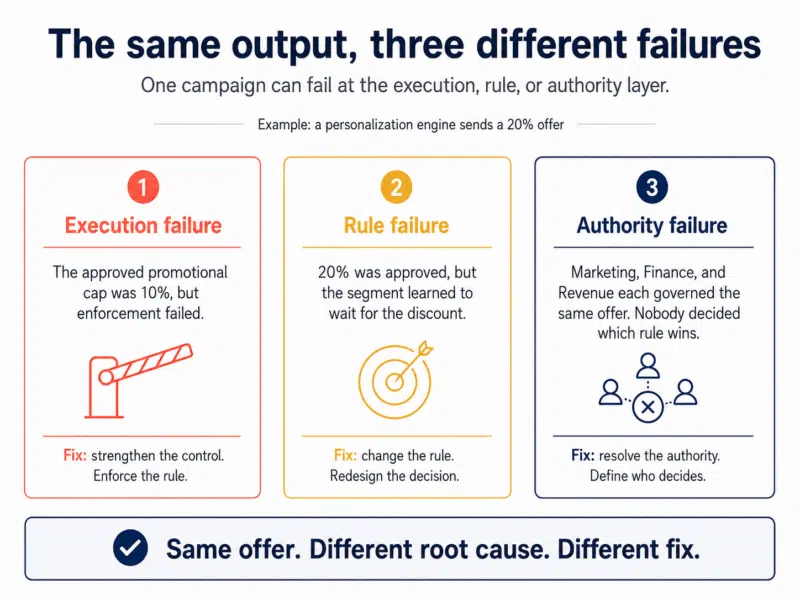
Your personalization engine extends a 20% offer to a high-value segment. In three separate scenarios, the receipt looks structurally identical — the same categories of context, authority, versioning, and action are all captured. The failures underneath aren’t the same at all.
Scenario 1
The approved promotional cap was 10%. The authority model was correct. Enforcement failed to hold the line. A stale rule in the campaign platform, a permission that didn’t propagate, a gate that didn’t fire. That’s an implementation bug, and it’s the one every team is prepared for.
Scenario 2
Twenty percent was the approved rule. The system followed it exactly as built. Three quarters later, the analysis comes back showing the segment has been trained to wait for the discount, and full-price conversion has collapsed. Nothing broke. The rule was legitimate, correctly enforced, and wrong. That isn’t an engineering failure — the decision architecture itself needs revision.
10X your SEO with Semrush for Enterprise.
The world’s most powerful SEO platform, purpose-built for Enterprise.
Request demo
Scenario 3
Marketing says the segment qualifies for the campaign. Finance says no offer may take a contribution margin below a set floor. Revenue says strategic accounts don’t receive any generalized promotional pricing.
All three rules genuinely govern this one offer. All three are legitimate, and nobody above the three of them had ever decided which one wins when they collide.
The build proceeded anyway, and something picked an interpretation — a vendor default, a config setting, an engineer making a reasonable call under deadline. The receipt will show that a rule was followed. It won’t show that the rule was ever authorized by anyone with standing to settle the conflict.
Same offer, three unrelated root causes. Fixing scenario one does nothing for scenario three. That’s why a receipt that only says “here’s what happened” isn’t finished doing its job.
That distinction is part of a broader AI governance taxonomy formalized in a working paper on Decision Architecture: what governs a system upstream, what enforces it at runtime, and what preserves evidence downstream.
The hardest bug may not be in the software
Engineering is very good at implementing a resolved specification. Give a competent team a clear rule, and they’ll build it correctly and enforce it consistently. It breaks down one level up — when the business hands Engineering an unresolved judgment disguised as a requirement.
Consider a smaller version. Your content engine drafts an email promising 24/7 dedicated support, because that phrase tested well in previous campaigns. It doesn’t know support cut weekend coverage three months ago. No rule was violated. No gate failed. The system optimized for exactly what it was told to optimize for, and produced a promise the company can’t keep.
Nobody had ever decided what the system is allowed to promise on the company’s behalf. That isn’t a prompt problem or a model problem. It’s an unmade decision, and it was unmade long before anyone wrote a line of code.
The same thing happens on a larger scale when systems collide. Marketing automation promises white-glove onboarding. The sales assistant offers a volume discount. The retention model flags the account as at risk and triggers a win-back credit.
Three systems, each performing correctly against its own objective, producing three contradictory messages to one customer in one week. Each receipt would show that a rule was being followed. None of them would show that anyone ever decided which system speaks last.
Engineering can’t legitimately make that call. It can only encode whatever answer it’s given, and when it isn’t given one, it supplies a default. The problem isn’t always enforcement. Sometimes, enforcement had nothing authoritative to enforce.
None of this diagnosis is possible without one prior thing: getting to the facts fast. Reconstruction means your team assembles the answer after the challenge arrives. Retrieval means the decision-time evidence already exists. Retrieval isn’t the destination — it’s the condition that makes diagnosis possible at all.
The correction loop
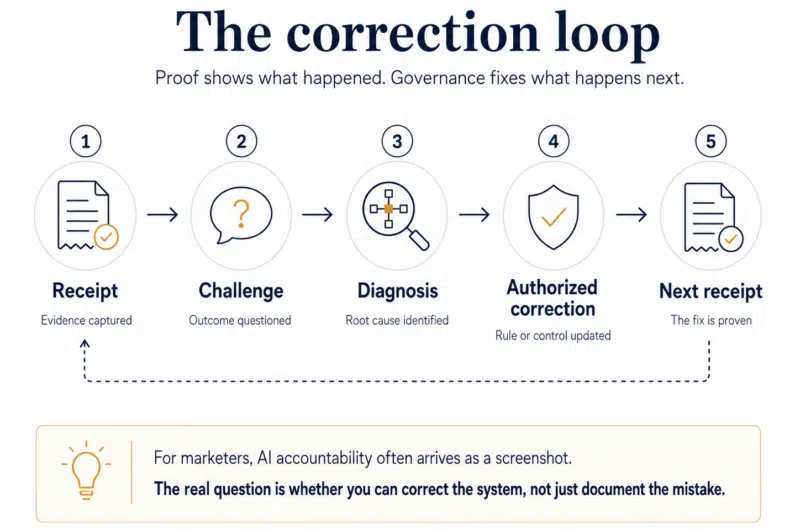
Here’s the part most governance conversations skip. A decision produces a receipt. The receipt gets challenged. Someone diagnoses which layer failed. A human with legitimate authority decides what should change. The rule or control is updated and implemented, and the next equivalent decision produces a new receipt — one that has to prove the correction actually held, not just that a change was made.
If the same exception keeps recurring, it shouldn’t require the same senior judgment call every time. When marketing, finance, and Revenue settle who wins on strategic-account pricing once, that resolution can become a new approved rule or an explicit escalation path, so the next campaign inherits the answer instead of relitigating it. But there’s a boundary: The AI doesn’t get to rewrite policy because it noticed a pattern. A human with legitimate authority approves the change. Only then does the system inherit it.
Auditability without correction is forensics. Governance is the ability to change what happens next.
The test that matters most
Marketers already know the screenshot test instinctively — could you stand behind this publicly, today, if a journalist posted it? Alongside it sit the board test and the audit test: Can leadership explain the decision, and can you retrieve rather than reconstruct it?
Those three are the baseline. The one most frameworks skip is the correction test: Once a decision is proven wrong, can you tell whether the fix belongs in the rule, the control, the implementation, or the authority behind the rule — and can you prove the fix held next time?
An organization that passes the first three and fails the fourth has excellent forensics and no learning loop. It will keep producing immaculate records of the same mistake, campaign after campaign.
Push this far enough, and the receipt stops being a defensive artifact. Every properly resolved exception becomes precedent. Every corrected rule improves the decision after it. Eventually, the organization isn’t just storing what it decided — it’s preserving why it decided it and what it learned.
If the receipt proves your AI was wrong, the useful question isn’t whether you can retrieve what happened. It’s whether you can tell if the failure sat in the execution, the rule, or the authority that created the rule — and whether, once you fix it, you can prove the fix held.
Proof tells you what happened. Governance becomes real when you can correct what governed it and prove the correction held.