

Marketers have spent the better part of a decade getting serious about measurement. We’ve built attribution models, invested in CDPs, fought over last-click vs. multi-touch and debated the finer points of incrementality testing. And yet, for many businesses, one of the highest-converting interactions in the entire customer journey still isn’t showing up in the data: the inbound phone call.
That measurement gap sits at the center of our newly updated “Call Analytics and Conversation Intelligence Platforms: A Marketer’s Guide” — and researching it changed the way I think about this category.
Call analytics platforms are evolving into marketing measurement infrastructure
When I started updating this report, I expected to be writing about call tracking. The research revealed a broader measurement infrastructure issue — specifically, the gap between what marketers can measure and what actually drives revenue.
Two structural forces are widening that gap.
The first is measurement pressure. Privacy regulations, platform policy changes and the ongoing erosion of third-party identifiers make it significantly harder to connect media spend to outcomes using traditional tracking methods. Marketers who relied on cookies, device IDs and cross-site signals to stitch together the customer journey are working with a patchwork that gets more frayed every year.
The second force is AI maturity. The capabilities available in call analytics and conversation intelligence platforms (CAPs) today are substantively different from what existed even a few years ago. In addition to tracking which ad drove a call, CAPs now transcribe conversations, apply natural language processing to detect intent and sentiment, score leads automatically, route callers to the agents most likely to convert them. They also push structured data back into CRMs, ad platforms and attribution models in near real time.
What was once a reporting tool is increasingly functioning as a data activation layer inside the marketing stack.
The combination of privacy-driven measurement disruption and AI-powered conversation analysis changes the value proposition of call analytics platforms. Conversation data is structurally different from almost everything else in a marketer’s first-party data stack.
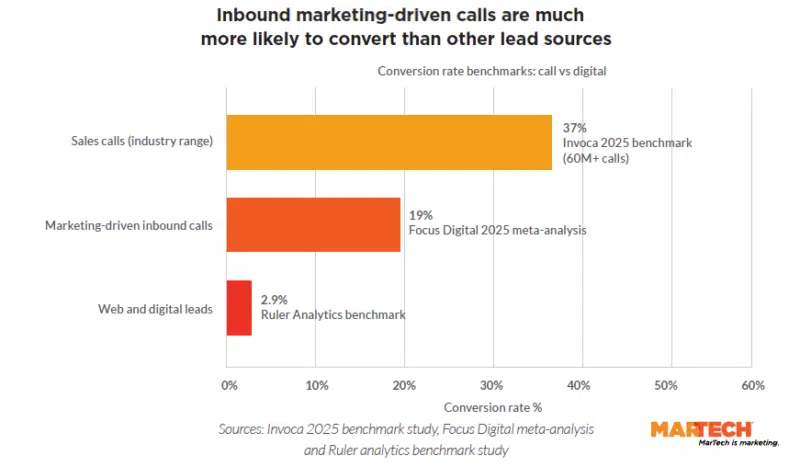
Conversation intelligence captures buyer intent that clickstream data cannot
Clicks tell you what someone did. Conversations tell you what someone actually meant.
A form fill gives you a person’s name, email and whatever they chose to type. A phone call reveals intent, urgency, objections, emotional tone, buying stage and the specific language a customer uses to describe their own problem. That is a different category of data that is difficult to capture anywhere else in the funnel.
CAPs are increasingly effective at converting unstructured conversation data into structured signals marketers can use. Machine learning models analyze language patterns, pacing and conversational dynamics to infer things like likelihood to convert and readiness to buy.
Vertical-specific training data improves accuracy in regulated industries — healthcare, financial services and legal — where terminology and compliance requirements differ significantly from general business conversations.
The first-party data angle matters as well. Conversation data is collected through direct, consent-based interactions with customers, which means it does not depend on third-party identifiers to remain useful. Conversation intelligence can persist as an analyzable data asset and inform targeting, personalization and attribution models even as privacy changes disrupt other measurement approaches.
Your customers search everywhere. Make sure your brand shows up.
The SEO toolkit you know, plus the AI visibility data you need.
Start Free Trial
Get started with

Conversation data is becoming one of the few attribution signals that remains stable as third-party identifiers disappear.
AI-powered conversation analysis exposes operational issues hidden in call sampling
One finding that stood out during the research was related to quality assurance.
Traditional QA processes typically sample between 1% and 2% of calls for manual review. AI-powered QA can analyze 100% of interactions.
That is not a marginal improvement in visibility. It represents a fundamentally different operational model.
When every conversation is analyzed, coaching opportunities, compliance risks, messaging inconsistencies and missed revenue opportunities become visible at scale. Problems that would never surface through small-sample QA programs can be identified quickly.
For marketers, the impact extends beyond the contact center.
Analyzing conversations at scale shortens feedback loops between campaigns and customer responses. Marketing teams learn faster when an offer is confusing, when ad messaging does not match what customers expect when they call, or when agent handling creates friction during high-intent interactions.
Conversation intelligence can provide real-time signals about campaign performance that traditional clickstream dashboards often miss.
AI competition is shifting the call analytics market toward conversation intelligence
The vendor landscape for CAPs is relatively stable, but the basis of competition is shifting.
Baseline capabilities — dynamic number insertion, call recording, transcription and lead scoring — have largely converged across the market. Differentiation is emerging in AI sophistication, attribution capabilities, omnichannel coverage beyond voice and compliance support.
A recent signal of where the category is heading came from Invoca’s 2025 acquisition of Symbl.ai, an AI-driven conversation intelligence platform with proprietary LLMs trained on human dialogue.
The acquisition shows that vendors are beginning to compete less on call-tracking functionality and more on the sophistication of their AI models and the richness of their conversational data assets.
The updated report covers nine vendors in depth, including profiles of platforms investing heavily in agentic AI and revenue-linked attribution.
If you are evaluating this category for the first time or reassessing an existing platform, the core evaluation question has shifted. The primary issue is no longer whether a platform can track calls. The more important question is whether it can transform conversation data into structured intelligence that connects marketing activity to revenue outcomes.
The report has a market overview, vendor capabilities, compliance considerations, pricing models and a detailed purchase evaluation framework. Readers can download the PDF, listen to the companion podcast or use the custom chatbot to ask questions specific to their situation.
The updated report walks through all of it — the market overview, vendor capabilities, compliance considerations, pricing structures, and a detailed purchase evaluation framework. You can download the PDF, listen to the companion podcast, or use the custom chatbot to ask questions specific to your situation.
Key takeaways
- Phone conversations represent one of the highest-intent interactions in many customer journeys, yet they are often missing from marketing measurement systems.
- Privacy changes and the erosion of third-party identifiers are increasing the value of first-party conversation data.
- Modern call analytics platforms combine transcription, AI analysis and CRM integration to transform phone conversations into structured marketing intelligence.
- AI-powered conversation analysis enables organizations to analyze 100% of customer interactions instead of relying on small QA samples.
- Competition in the vendor market is shifting from call tracking functionality toward AI sophistication, conversation intelligence and revenue attribution capabilities.