
At the November MarTech Conference, Scott Brinker — editor of Chiefmartec.com — delivered a keynote on how agentic AI will transform marketing. Drawing on decades in marketing technology, Brinker walked through why AI is more than a speed boost, how agents fit alongside traditional automation, and what this shift means for marketers’ jobs in the years ahead.
From scarcity to abundance (and a new creative range)
Brinker opened with a simple metaphor: slide creation. Forty or 50 years ago, producing a professional slide deck took specialized craft and weeks of work — physical boards, knives, rubber cement, film and no easy edits. The number of presentations any company could make was inherently limited.
Then came tools like PowerPoint, democratizing slide creation. Today, AI slide tools can draft, design and export complete presentations in minutes from a short prompt. Brinker showed how he generated a deck outline, had AI apply a style, fixed the aspect ratio with a single instruction, then exported to PowerPoint — “two or three minutes” from idea to working deck.

For Brinker, this is a metaphor for what’s happening across martech: We’re moving from scarcity to abundance. It’s not just more output or faster cycles; AI is expanding the creative range of what marketers can reasonably attempt.
That abundance is visible in the marketing technology landscape. Over the years, the number of tools has exploded into the tens of thousands, with AI kicking off a fresh growth spurt. The curve has started to flatten a bit, but the overall ecosystem still grew roughly 10% year over year. Marketers now face a long tail of platforms, horizontal tools and specialized solutions — each adding more options for how to apply agentic AI.
The spectrum: From rules-based automation to agentic autonomy
Brinker urged marketers not to treat “agentic” as a mandatory end state. Instead, he described a spectrum of capabilities:
- On one end: traditional rules-based automation — predictable, explainable, repeatable, but static.
- On the other: autonomous agents — probabilistic, variable, adaptive but riskier and less controllable.
Agents can make decisions and adapt in ways static workflows can’t, but that autonomy comes with trade-offs. They may do things differently than you intended or in ways that are harder to audit.
The key, Brinker stressed, is that this is not a maturity ladder where everyone must rush from rules to full autonomy. There is a rich opportunity in the middle — embedding AI decisions within structured workflows, or letting agents handle specific tasks while guardrails, logic and oversight remain firmly in human hands. Marketers don’t need to “agentify everything” to create value.
Three categories of agents marketers must think about
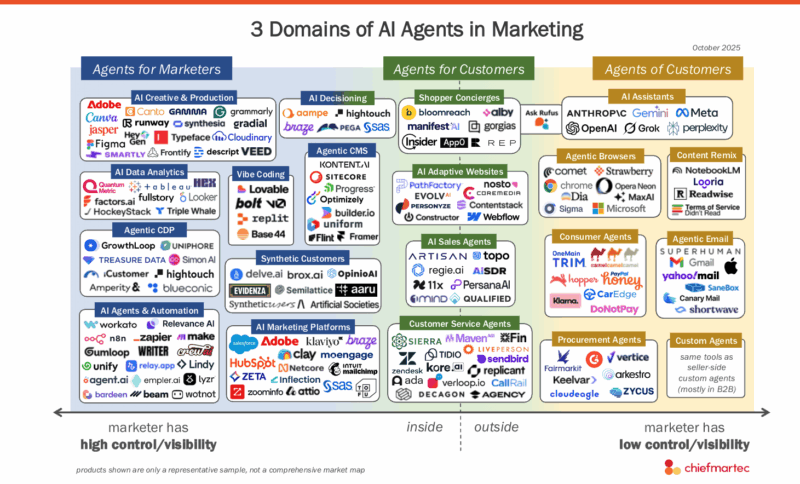
Brinker distinguished between three broad types of agents that already affect marketing.
Agents for marketers (backstage)
These are agents that work for the marketing team: AI-augmented features inside major platforms, analytics helpers, creative copilots and agent-enabled workflow tools. They accelerate production and analysis behind the scenes.
Agents exposed to customers (you control them)
Customer service bots, AI SDRs and email agents interact directly with customers while still under the brand’s control. When they work well, they offer faster resolution and better responsiveness. But they must improve customer experience, not just internal efficiency.
Agents of customers (you don’t control them)
This is the most disruptive category. Consumers now research via general AI assistants and “answer engines” such as ChatGPT-like tools or AI-powered browsers. These agents read your content, reviews and pricing — and then mediate how customers perceive you. Marketers can’t control them, only influence them, similar to but more complex than traditional SEO. Brinker sometimes refers to this as AEO/GEO — answer/guide engine optimization.
He predicted that just as AI is reshaping search and web journeys, it will eventually reshape the inbox as AI assistants triage, summarize and reframe marketing emails on behalf of users. Marketers will be speaking to customers through agents more and more, not just directly.
Automation vs. experience: A two-by-two worth keeping
When deploying customer-facing agents, Brinker urged marketers to be careful. AI makes it tempting to automate anything that saves time or cost, but customer-facing automation must satisfy a two-by-two:
- Does it improve company efficiency?
- Does it improve customer efficiency and experience?
If it only helps the company while making the customer’s life harder — forcing them through rigid bots, unhelpful loops or opaque flows — it becomes a negative marketing experience. Brinker’s warning: Use agents to serve both sides of the relationship.
Vibe coding, no-code and software you don’t realize you’re writing
One of the more mind-bending parts of the keynote was Brinker’s discussion of “vibe coding.” In practice, many AI models now turn natural-language prompts into actual code behind the scenes.
Brinker gave an example: asking an AI to gather data on the most valuable companies over 20 years, split by tech vs. non-tech, and graph the result. The model returned a chart in about 30 seconds — but under the hood, it had written JavaScript, built a small web app (e.g., in React), and executed it. A marketer interacting in plain English had effectively “created software” without realizing it.
He joked about “vibe coding” as a buzzword — calling it a modern cousin of no-code/low-code — but underscored its power for simple, internal, low-risk tools:
- Small web apps or prototypes.
- Internal utilities for a few users.
- Short-lived tools for events or campaigns.
- Fuzzy ideas that need quick, hands-on exploration.
These use cases were historically underserved not for lack of ideas, but because the time, cost and expertise to build them weren’t justifiable. Agentic AI changes that equation, moving more technology from centralized IT services to decentralized self-service in marketing. The result: more speed, more parallel experimentation, and more learning.
From centralized services to decentralized makers
Brinker framed this as a major shift in how marketing work gets done:
- Historically, much technology lived in IT or specialized ops teams; marketers had to queue for support.
- As tools became more accessible (low-code, no-code, now agentic AI), more capabilities moved into the hands of practitioners.
- The “cost” of building experiments—campaigns, micro-experiences, internal tools — continues to fall, so the volume and diversity of experiments can rise.
He cited Linus Pauling’s line—“The best way to have a good idea is to have a lot of ideas”—to argue for broad experimentation. Many experiments will fail, and that’s acceptable; what matters is that as the funnel of ideas widens, the absolute number of winners increases too.
For Brinker, this is the heart of the agentic AI opportunity: empowering a broader group of marketing makers to try more things, faster, without waiting months for formal projects or specs.
Will AI take marketing jobs?
Brinker tackled the fear directly with a simple breakdown of marketing work into three buckets:
- Strategy and creative.
- Production and analysis.
- MarTech and marketing operations.
Historically, most time has gone into production and analysis — even though most prestige is attached to strategy and creative. AI and agents will dramatically reduce the effort required for production and analysis: generating variations, pulling reports, synthesizing data, and orchestrating flows.
Leaders now face a choice:
- Treat this as a pure cost-cutting opportunity and shrink teams, or
- Reinvest the freed capacity into more strategy and creative, more experimentation, and stronger ops to support a higher tempo of learning.
Brinker argued the second path is the only sustainable advantage. Efficiency gains from AI will soon be a commodity — every business will enjoy cheaper production. Differentiation will come from how organizations use that freed capacity: bolder ideas, more personalized experiences, faster test-and-learn cycles and more robust supporting infrastructure.
In his view, the marketers who lean into:
- Expanding strategy and creative,
- Building reliable, scalable marketing operations to support rapid experimentation, and
- Learning how to work with agents as collaborators,
will be in a strong position “for many, many years to come.”
Key takeaways for marketers
From Brinker’s keynote, a few practical themes emerge:
- Think in spectra, not absolutes. You don’t need to replace all workflows with agents. Blend rules-based reliability with agentic flexibility where it makes sense.
- Recognize the three-agent world. Agents for marketers, agents you expose to customers, and agents of customers (independent assistants) each require different strategies.
- Optimize for agents as new “audiences.” Structure content, data, and experiences so AI assistants can parse, summarize, and represent your brand accurately.
- Use efficiency gains to fuel learning, not just cuts. The real advantage will come from smarter strategy, richer creative, and more robust experimentation—not just doing the same things cheaper.
In short, agentic AI is not just about automation; it’s about redefining what marketers spend their time on. Machines will increasingly handle the heavy lifting in production and analysis. The marketers who thrive will be those who use that shift to think bigger, test more bravely, and build the systems that turn abundant possibilities into durable performance.
Contributing authors are invited to create content for MarTech and are chosen for their expertise and contribution to the martech community. Our contributors work under the oversight of the editorial staff and contributions are checked for quality and relevance to our readers. MarTech is owned by Semrush. Contributor was not asked to make any direct or indirect mentions of Semrush. The opinions they express are their own.