

AI is changing what the CMS is expected to do. What used to be a publishing system is becoming the control layer for how brands are discovered, understood, personalized, and transacted across human and machine experiences. The CMS is now where brands provide structured context that AI systems use to discover, understand, validate, and recommend them. For CMOs and CDOs, the next CMS decision is not a technology upgrade. It is a choice about who controls your brand’s context, trust, and visibility in an AI-mediated market.
For years, the CMS was a publishing platform. Marketers created content, editors approved it, and customers consumed it on websites. That model is evolving fast. The CMS and DXP are becoming the central, authoritative data layer, shifting from delivering web experiences to powering AI engines.
The stakes are rising fast. Google zero-click searches reached 68% in early 2026, and McKinsey estimates 20% to 50% of traditional search traffic is at risk as AI captures more discovery and purchase decisions. For a growing share of queries, being cited in the answer is the only visibility a brand gets. Google now points brands toward agentic experiences and protocols like the Universal Commerce Protocol.
The decision shifted from adding AI to the CMS toward rebuilding the CMS around AI. By early 2026, most marketing organizations used AI agents. The question is no longer whether to adopt AI, but which system governs how AI discovers, understands, and represents your brand.
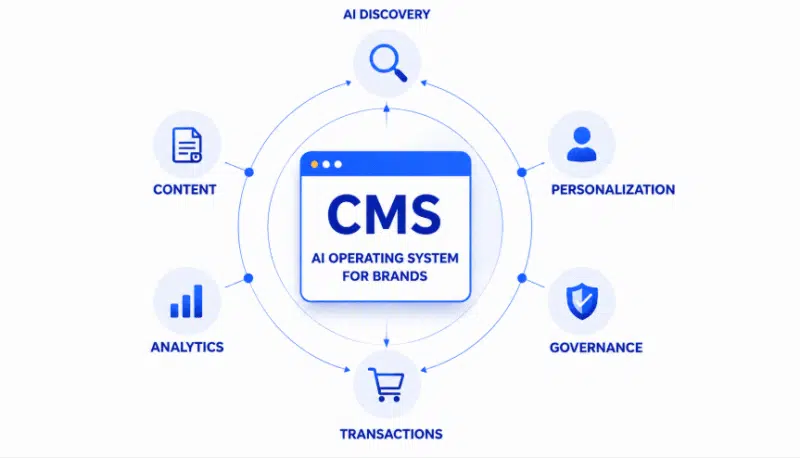
AI trusts brands through structured content, entities, and governance, not just web pages. That’s why the CMS is becoming an AI operating system: the governed intelligence layer behind personalization, search, and agents.
Your customers search everywhere. Make sure your brand shows up.
The SEO toolkit you know, plus the AI visibility data you need.
Start Free Trial
Get started with

Why the CMS is becoming the AI operating system for brands
As AI becomes the primary interface for discovery and commerce, the CMS manages the content, context, governance, and intelligence that represent a brand. Five shifts define the move.
- AI-powered content operations: AI runs the full content lifecycle, from creation to localization and measurement, building a connected, contextually relevant supply chain rather than simply producing more content faster.
- Agentic workflow automation: Embedded agents recommend actions, coordinate tasks, and route approvals under human oversight.
- Structured and composable content: AI performs best when content is organized as reusable entities, attributes, and metadata with an entity-aware schema that works across sites, apps, assistants, engines, and agents.
- Experience orchestration: The CMS serves as the orchestration layer, activating content, context, and data to deliver personalized conversational experiences.
- Governance and trust: Guardrails, not raw generation, are the real differentiator.

The CMS is moving from page management to orchestration, giving AI four things it can’t safely operate without.
- Structure turns content into machine-readable knowledge. Connect your entities with schema so AI engines understand your business. Secure your knowledge panel before someone else shapes it.
- Context keeps output relevant to audience, intent, geography, and brand voice rather than generic.
- Governance enforces trust because too many organizations buy on features but fail on fundamentals: data, architecture, and governance.
- Execution makes the CMS operational, coordinating fixes, test variations, localization, optimization, and agents that complete multistep work.
Marketing teams need speed, personalization, and consistent brand experiences at scale. Data teams need structured, trusted, governed, and AI-ready content. Your CMS must deliver both. As search shifts to answers, discovery to citations, and personalization to real-time orchestration, the CMS becomes the operating system for AI-driven experiences. The winners unify content, structured data, governance, and agentic execution into a single AI-enabled operating model.
What the AI-era CMS must actually do
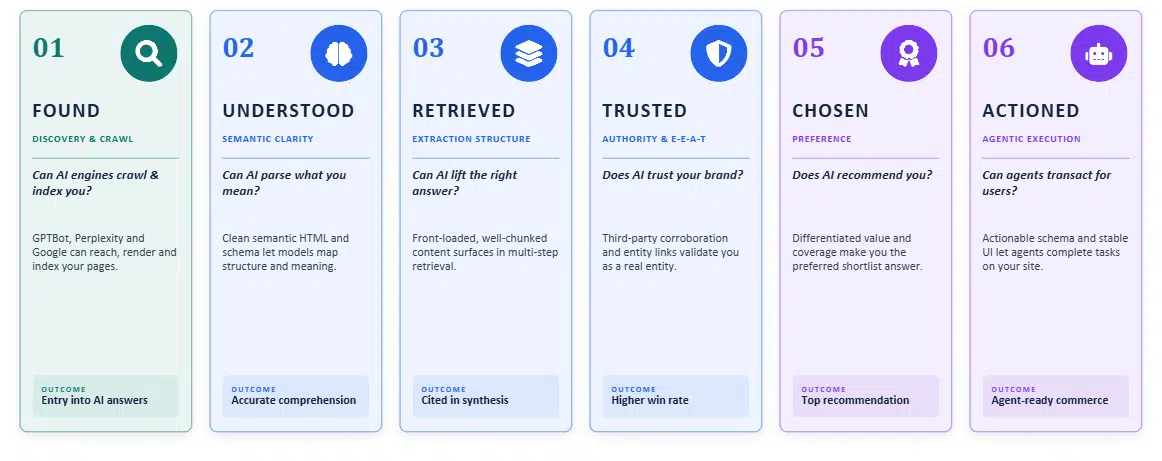
Adding a generative assistant to a legacy CMS doesn’t make it AI-native. The CMS must help AI engines find, understand, retrieve, trust, recommend, and act on brand content.
Six outcomes now shape the journey, often before a visitor lands on the site.
- Found: Can AI engines crawl, render, and index the brand? The CMS should make machine readability automatic and flag invisible pages before publishing.
- Understood: Can AI parse what the brand means? The CMS should map entities, relationships, and context to one trusted source. The principle is clarity over density: A well-defined concept with well-connected related subtopics outperforms a keyword-dense paragraph every time.
- Retrieved: Can AI give the right answer? The CMS should shape content for extraction, not just reading. Treating each 100- to 300-word chunk as a self-contained mini-article still makes sense, as retrieval-augmented generation systems favor these bite-sized knowledge nuggets when quoting content in isolation.
- Trusted: Does AI trust the brand? The CMS should build validation, corroboration, and consistent entity signals into the publishing process.
- Chosen: Does AI recommend the brand? The CMS should support differentiated value, fresh content, and personalization that make the brand the preferred answer.
- Actioned: Can agents complete tasks? The CMS should expose trusted offers, availability, policies, and interfaces that agents can act on.
To deliver these outcomes, platforms need governed generation, no-code workflows, predictive personalization, and self-monitoring infrastructure. The goal is simple: Make fast content governed and governed content fast to support agentic discovery.
CMS readiness checklist for the agentic era

Traditional CMS capabilities, including authoring, templates, permissions, APIs, and integrations, still matter. But in an AI-driven world, the real question is different: Can your CMS help AI discover, understand, trust, and act on your brand? Use these eight pillars to evaluate whether your platform is ready for the next generation of search, assistants, and agents.
1. Entity coverage and disambiguation
AI needs to clearly understand who you are, what you offer, where you operate, and how everything is connected. Your CMS should automatically create and maintain relationships between products, services, locations, people, and organizations through structured content, schema, and entity graphs.
Measure: Entity coverage, schema accuracy, and knowledge graph completeness.
2. Discoverability
If AI can’t access and understand your content, it can’t recommend or cite it. Your CMS should support clean architecture, fast crawling, efficient indexing, and machine-readable content that’s easy for AI systems to retrieve and process, a foundational point in Google’s own guidance.
Measure: AI crawler access rate, crawl errors, indexing rate, and content accessibility.
3. AI visibility
AI systems select and cite content they consider relevant, trustworthy, and authoritative. Your CMS should help make content easy to retrieve, understand, and reference in AI-generated answers.
Measure: AI share of voice, citation rate, AI referral traffic, AI-assisted conversions, and brand mentions.
4. Governance and trust
Every AI-driven change should be accurate, compliant, auditable, and aligned with brand standards, with clear approval workflows and human oversight.
Measure: Approval compliance, content accuracy, auditability, traceability, and content freshness.
5. Orchestration and execution
The CMS should help teams act on insights by automating recommendations, workflows, localization, testing, optimization, and content delivery across channels.
Measure: Time-to-action, localization coverage, and experiment velocity.
6. Agentic commerce and transactions
Customer journeys are moving beyond websites toward AI assistants and agents. The CMS should support agent-ready standards and protocols such as NLWeb, MCP, ACP, A2A, and UCP.
Measure: Protocol coverage, agent-ready transaction coverage, task completion rate, AI-influenced revenue, and agent-assisted conversions.
7. Self-monitoring and self-healing
Platforms must continuously monitor performance, identify issues, recommend fixes, and increasingly resolve problems automatically.
Measure: Schema compliance, core web vitals, issue detection speed, resolution time, and auto-remediation rate.
8. Industry context
The CMS should support industry-specific entities, customer journeys, business rules, local signals, and conversion moments without extensive customization.
Measure: Industry model coverage, local visibility, conversion performance, and representation accuracy.
A platform that delivers these eight capabilities acts like an AI operating system. One that can’t may still publish pages, but it limits safe, fast, visible growth in an AI-driven market.
The decision ahead
Many organizations will re-platform to improve authoring, workflows, and productivity. The real question is whether the CMS can help AI discover, understand, trust, personalize, and act on behalf of your brand. That demands a platform that structures knowledge, enforces governance, measures AI visibility, and enables agent-driven interactions.
In the old web, the CMS determined what customers could see. In the AI web, it shapes what machines understand, recommend, cite, and transact, making it one of the enterprise’s most important strategic control points.
Acknowledgment: I thank the Milestone team, especially Hardik, Aninda, and Timothy, for their valuable contributions and support in bringing this article together.