

One of the most rewarding aspects of teaching marketing is seeing how my students tackle real-world business challenges.
Every semester, I review the final projects from my Honors Marketing students at the University of Missouri-St. Louis. This semester was no exception, with students creating marketing plans for organizations across fintech, healthcare, retail, and manufacturing.
As I dove into their work, I looked for common threads. I expected discussions about AI, debates around channels, technology, and emerging trends. Instead, a different pattern emerged.
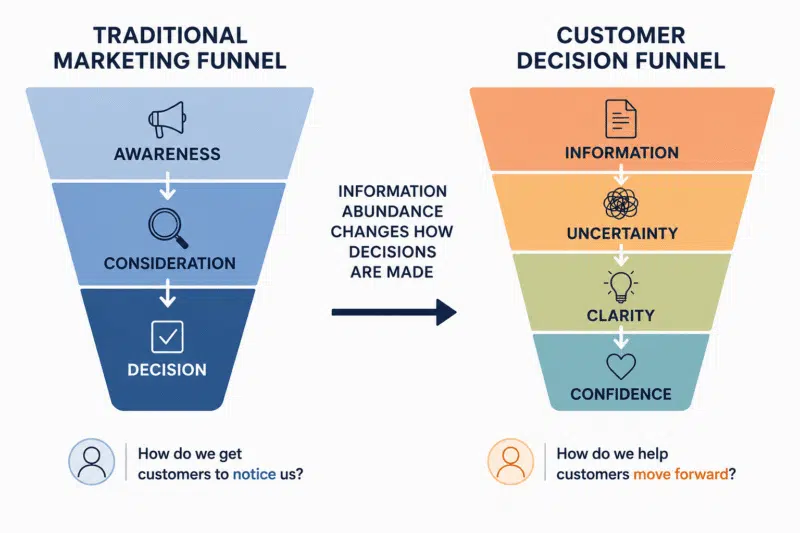
Regardless of the industry, the most impactful projects homed in on a single, powerful theme: helping customers navigate uncertainty. It wasn’t about giving customers more information. It was about giving them more clarity.
The more I reflected on it, the more I realized it extended well beyond the classroom. We’re all dealing with a flood of AI-generated content, information overload, declining trust, and increasingly complex buyer journeys.
The problem isn’t a lack of information. Customers have more data, answers, and options than ever before.
Your customers search everywhere. Make sure your brand shows up.
The SEO toolkit you know, plus the AI visibility data you need.
Start Free Trial
Get started with

What happens when buyers have too many answers?
We’ve long competed for attention. We built our playbooks around a simple idea: get noticed. More content, more campaigns, more channels, all in service of reaching the right person with the right message at the right time.
That still matters. But a different challenge is emerging.
Many customers aren’t struggling to find information. They’re struggling because they’re drowning in it. Think about someone researching a new product today. They can compare vendors, read countless reviews, watch demos, and scroll through endless social media chatter. Information is everywhere.
The real problem is interpretation. Questions like these increasingly shape buying decisions:
- Which sources can I trust?
- Which product differences actually matter?
- How can I feel confident I’m making the right choice?
Those questions grow more urgent as AI-generated content explodes. Buyers are wading through more recommendations and opinions than ever, while economic pressures and declining trust make every decision feel like a risk.
Many buying journeys don’t stall because customers choose a competitor. They stall because customers feel overwhelmed. I touched on this in a previous MarTech article about decision paralysis. Buyers often delay making a choice when the perceived risk is too high.
If customers are overwhelmed, creating more content isn’t always the solution. The opportunity is reducing uncertainty.
Helping customers feel confident enough to move forward
What struck me most was how naturally my students thought this way. Instead of asking, “How do we get customers to notice us?” they started with a different question: “How do we reduce uncertainty?” A few examples illustrate the point.
- A fintech concept aimed at first-time investors focused on reducing financial anxiety. Rather than leading with flashy promotions, the strategy centered on education, helping customers feel comfortable and confident enough to take those first steps.
- A collision repair project tackled a different kind of uncertainty. After an accident, most people have no idea what to do next. The students emphasized proactive communication and transparency, not because those tactics are revolutionary, but because uncertainty itself was the problem to solve.
- Students working on restaurant and hospitality concepts took a similar approach. Instead of promoting menu items, they focused on making unfamiliar dining experiences feel more approachable. The goal was to help customers feel confident enough to try something new.
- Even the B2B projects reflected the same mindset. One team working with a manufacturer centered its plan on helping buyers navigate operational complexity and questions about reliability. The strategy helped prospects better understand the decision they faced.
Across industries, the students approached marketing as a way to help people make decisions, not simply persuade them to buy. They treated marketing and customer experience as inseparable.
For this generation, that mindset comes naturally. Helping customers cut through complexity isn’t just a nice-to-have. It’s the cost of entry.
Why clarity becomes more valuable as AI scales
Looking across the projects, I noticed a broader pattern. They weren’t just creating content. They were responding to something many of us feel every day: we’re drowning in information, not starving for it.
Marketers now have tools that let us produce content at lightning speed. The easier it is to create information, the more customers have to sift through.
More information doesn’t always lead to better understanding. Often, it creates more confusion and uncertainty. This is classic decision paralysis. Faced with too many choices, people often make no choice at all.
As AI plays a bigger part in how buyers find and process information, our role shifts from producing content to helping customers make confident decisions.
AI is a powerful tool, but it can also make the problem worse. If we use it only to generate more content without considering whether it actually helps customers, we’re adding to the noise. We end up with a mountain of information and very little clarity.
As content becomes easier to create, trust and a distinct brand voice become even more important. The brands that stand out won’t be the ones publishing the most content. They’ll be the ones who help customers understand what it all means.
I’ve touched on this before in a previous MarTech piece about the rise of generic AI content. Scale alone doesn’t make you stand out. A unique point of view does.
What future marketers may be seeing
The most important takeaway wasn’t the quality of my students’ ideas. It was the mindset behind them. They didn’t start by asking how to generate more impressions. They started with a different question: “How do we build trust and reduce uncertainty for our audience?”
The more I reflect on their work, the more I think they’re showing us where marketing is headed. As AI makes information easier to create, clarity becomes more valuable.
Customers don’t need more information. They need more clarity.