

HubSpot and Salesforce both recently announced major changes to their partner programs — moves that executives say will improve quality and help partners deliver better AI-driven outcomes. But analysts and partners see something bigger: a strategic reset as both companies compete to remain central platforms in an AI-driven software stack.
The changes affect how partners qualify, how they make money and what expertise they’re expected to bring to customers. Together, they signal a shift away from broad partner ecosystems toward smaller groups of deeply specialized firms.
Industry analyst Jay McBain, chief analyst for channels, partnerships and ecosystems at Canalys (now part of Omdia), said the shift reflects a larger transformation underway across the technology industry.
“We watch about 35,000 companies delivering channel partner programs,” McBain said. “Almost 400 companies have now made these kinds of changes. It’s an evolution of how partner ecosystems work.”
Two platforms, two partner program overhauls
Salesforce and HubSpot are approaching the transformation differently, reflecting the different roles partners play in their ecosystems.
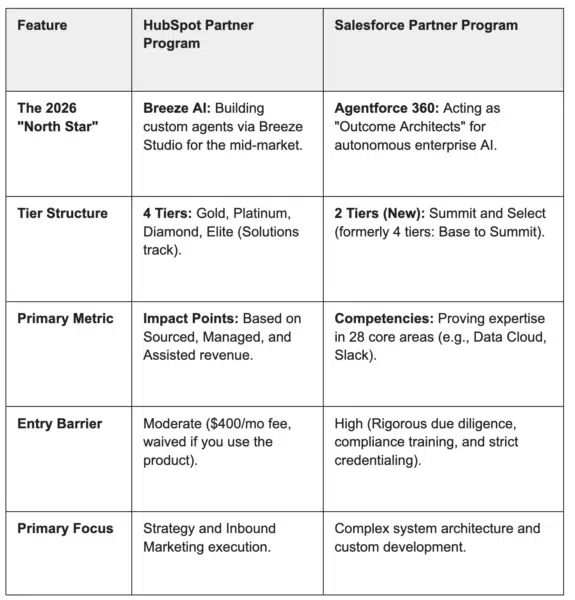
Salesforce announced a sweeping overhaul of its consulting partner program in March 2026, replacing its long-standing four-tier system — Base, Ridge, Crest and Summit — with a simplified two-tier structure: Select and Summit.
The company also dramatically reduced the number of partner credentials, replacing roughly 170 badges with 28 core competencies. Partners are now ranked as Accredited or Expert depending on demonstrated delivery capability.
Salesforce leadership framed the move as a shift from traditional systems integration toward what it calls “outcome architecture.”
Salesforce executives say the changes are designed to align partners with the company’s AI-driven strategy, particularly its Agentforce platform. In announcing the new structure, Andrew Kisslo, Salesforce’s SVP of partner programs, described the system’s goal.
“Rewarding the experts who ensure agents are secure, compliant and built for verifiable outcomes,” he wrote a blog post. “This program is designed to recognize partners who deliver real customer value and help organizations deploy AI safely and responsibly.”
Industry observers say the change also addresses a structural problem that emerged as the ecosystem grew. Sasha Semjonova, in an article on SalesforceBen, reported that the previous system had become crowded, with thousands of partners holding top-tier status.
“The new framework dramatically reduces the number of badges and focuses on core competencies instead. The goal is to restore the Summit tier as a truly elite status for the most capable partners in the ecosystem.”
HubSpot introduces membership model
HubSpot’s changes focus less on certifications and more on partner participation. The company introduced a $400 monthly membership fee for solutions partners, with the cost waived for partners who actively use the platform.
HubSpot leadership says the goal is to ensure partners are deeply engaged with the technology they sell, particularly as the company expands its Breeze AI ecosystem. The company argues that requiring partners to be active customers ensures they understand the platform firsthand.
Some partners see the change as part of a broader shift in expectations.
Revenue operations consultant Casey Hawkins wrote on LinkedIn that the new structure signals that HubSpot expects partners to be much more embedded in the ecosystem.
“This change makes it clear HubSpot wants partners who are truly operating inside the ecosystem. Agencies that only occasionally implement HubSpot or treat it as one of many tools probably won’t see the same value in the program going forward.”
Your customers search everywhere. Make sure your brand shows up.
The SEO toolkit you know, plus the AI visibility data you need.
Start Free Trial
Get started with

Others say the change will narrow the ecosystem by removing inactive agencies. Rolf Tjalsma wrote on LinkedIn that the update signals a shift in how the company wants partners to engage with the platform.
“HubSpot is sunsetting its low-cost partnership model. It looks like they want a smaller group of partners who are more deeply invested in the product and the ecosystem.”
The change also reflects a shift toward deeper platform specialization. Zack Spear, CEO and co-founder of ICS Creative Agency, raised that question directly on LinkedIn.
“What happened to the HubSpot partner program? It feels like HubSpot is raising the bar and pushing agencies to decide whether they’re truly committed to the platform or just loosely participating in the ecosystem.”
A shift in how partner ecosystems work
The changes reflect a deeper shift in how software companies use channel partners.
Historically, most industries relied heavily on indirect sales through partners. McBain noted that roughly 75% of global trade still flows through partner ecosystems, from car dealerships to retail distribution. Software largely followed that pattern — until SaaS.
“When Salesforce launched in the late 1990s, there wasn’t really a resale model,” McBain said. “You don’t subscribe to Netflix through the cable guy. You subscribe directly.”
Because SaaS products were sold directly, companies like Salesforce and HubSpot never built the traditional channel margins common in hardware and legacy enterprise software. But the rise of AI — particularly large, complex transformation projects — is changing that dynamic.
“If SaaS platforms want a seat at the table for these AI transformation projects,” McBain said, “the consultants who control the boardroom conversations have to be recommending them.”
In large enterprise deals, those conversations increasingly involve multiple partners.
“There are often seven partners inside a deal,” McBain said. “If those partners are telling the client to use Microsoft Copilot or go directly to OpenAI or Anthropic instead of using the SaaS platform, that’s a problem.”
The AI platform battle
That dynamic is driving what analysts describe as a new “AI platform war.”
Both Salesforce and HubSpot recently introduced AI agent platforms — Salesforce Agentforce and HubSpot Breeze — designed to automate workflows and customer interactions. These tools could redefine the role of CRM platforms, transforming them from systems of record into AI-driven operating layers for businesses.
See the complete picture of your search visibility.
Track, optimize, and win in Google and AI search from one platform.
Start Free Trial
Get started with
But that raises new risks. Autonomous AI agents can produce incorrect outputs or execute workflows incorrectly — a problem widely referred to as AI “hallucination.” That risk increases dramatically when implementations are poorly configured. The new partner requirements may be designed, in part, to mitigate that risk.
Salesforce’s competency-based accreditation system, for example, ensures that only partners with specific expertise can implement key technologies. That reduces the likelihood that poorly implemented AI agents could damage a customer’s business — or the platform’s reputation.
The end of the generalist agency
Across both ecosystems, the changes point toward a common theme: the decline of the generalist implementation partner.
HubSpot partners historically focused on helping customers get up and running quickly, emphasizing lower total cost of ownership and faster deployment. Salesforce partners, by contrast, often built complex, customized implementations that integrated multiple Salesforce clouds and external systems.
But AI is reshaping both models.
Automation is reducing the manual configuration work required for software implementation. That change threatens the traditional consulting model, which is based on long, billable implementation projects. The platforms are pushing partners away from being generalists in implementation and toward deeper technical specialization or higher-level strategic services.
Partners will increasingly need to choose whether they specialize in strategy, data architecture or platform engineering.
A broader industry trend
McBain said these changes should be viewed in the context of a broader shift in the software ecosystem.
The rise of hyperscalers such as Microsoft, AWS and Google — along with new AI companies like OpenAI and Anthropic — is reshaping the technology stack. For SaaS companies, the risk is losing their role as the foundational platform in enterprise systems.
“The next generation after cloud looks like hyperscalers and AI companies,” McBain said. “That puts pressure on SaaS platforms to prove they’re still the layer that matters.”
Partner ecosystems play a crucial role in that competition.
“If the consultants in the room are recommending another platform,” McBain said, “that’s where the deal goes.”
The “great thinning” of partner ecosystems
The Salesforce and HubSpot changes — both announced within months of each other — indicate the start of a major ecosystem consolidation, which analysts are calling “the great thinning.”
After years of rapid growth in partner networks, platforms may now prioritize depth of expertise over sheer numbers of partners. The end result is fewer partners, but more capable ones.
That shift will reshape the agency landscape as well.
Historically, many marketing agencies claimed expertise across multiple CRM platforms. But deeper certification requirements and tighter platform alignment may make that harder to sustain. Now agencies may have to choose whether they are a Salesforce or a HubSpot shop.
The long-term impact
In the near term, the partner program changes will create friction as agencies adjust to new requirements and incentives. The bigger question is how the changes will affect the role of CRM platforms in the emerging AI stack.
If the strategy works, Salesforce and HubSpot could reinforce their position as the central operating layer for business workflows. If it fails, AI platforms and hyperscalers could capture a larger share of enterprise software value.
For McBain, the stakes are clear.
“These platforms are very safe,” he said. “The question isn’t whether they survive. The question is how much of the AI economy they capture.”
And that outcome may depend less on technology than on the strength of the ecosystems built around it.