Updated with details on TikTok’s new US-based ownership.
TikTok is mainly seen as a prime venue for Gen Z to share dance crazes, which can be perfect for B2C marketers. However, its reach is far broader than that. According to Meltwater, TikTok ads have the potential to reach 48.8% of people over the age of 18 in the U.S.
So, it’s useful for B2B marketers, too. Also, the Gen Z cohort is moving up into positions to make purchase decisions.
What makes it suitable for B2C applies to B2B as well. It is an essential tool for brands to connect directly with customers. It offers opportunities for in-app shopping, live-streaming and branded hashtag challenges. However, marketers must understand and work with TikTok’s culture to succeed.
This guide covers key data, user demographics, marketing strategies, content creation and best practices for B2B success on TikTok.
Customize this content for your job role
Use the form below and MarTechBot will personalize the content on this page according to your job role. If you’d rather not personalize the content, simply keep reading.
Why use TikTok for B2B marketing?
While the platform initially appealed primarily to Gen Z and younger millennials, it experienced significant growth among older demographics and professional audiences. Today, many decision-makers and industry professionals turn to TikTok for both informational content and entertainment, positioning it as a valuable channel for engaging B2B audiences. Additionally, it is important to note that B2B decision-makers have been getting younger in recent years, and a significant proportion are now of digital natives.
The app’s short video format allows for presenting intricate topics in an engaging and easily digestible manner. Furthermore, TikTok provides various advertising options, including targeted ads and influencer collaborations, making it easier to reach specific B2B audiences.
Dig deeper: How influencer marketing became an essential marketing channel
Data from TikTok and Nielsen also found that the platform is the fastest-growing channel for product discovery. According to the data, 15% of product discoveries begin on TikTok. According to TikTok data, advertisers are now seeing an average return of $2 for every $1 spent.
Fuel up with free marketing insights.
Demographics
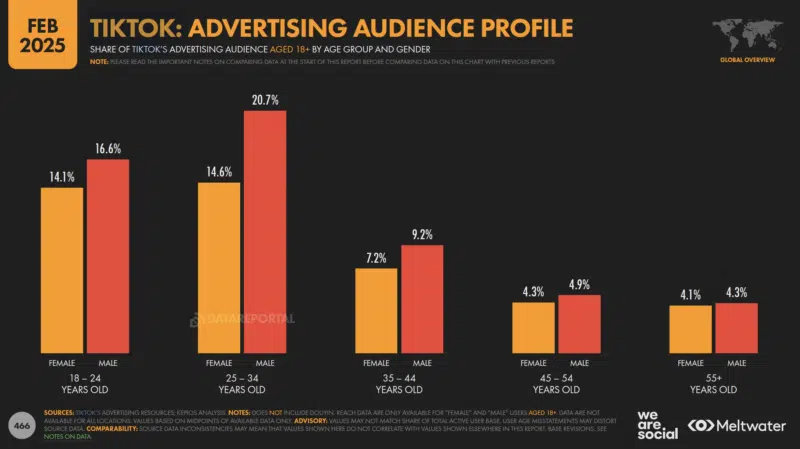
Gender distribution: TikTok’s user base is relatively balanced in gender, with 54% identifying as male and 45% identifying as female.
Age distribution: While TikTok is popular among younger generations, a substantial portion of its audience comprises older demographics. For example, 21.7% of TikTok’s US user base are Millennials. Also:
- 18.2% of TikTok’s global audience are women aged 18-24 and women aged 25-34 make up 16.3% of users.
- Young male users account for 18% of TikTok’s audience.
- 19% of global TikTok users are men between 25 and 34 years old, while 18% are men between 18 and 24 years old.
Geographic distribution: The top three countries with the most TikTok users are the United States, Indonesia and Brazil. The U.S. has the largest TikTok audience, with 148 million monthly unique users. Indonesia has 126.83 million users and Brazil has 98.59 million users.
Small business owners: Small business owners represent a significant community on TikTok. More than half (52%) of users exposed to SMB (small and mid-size business) content on TikTok made purchases, demonstrating the platform’s power to drive intent, according to a report by The Drum.
The culture of TikTok
- Short-form video focus: TikTok thrives on short, viral videos, often incorporating music and trending sounds.
- Trend-driven culture: Success on TikTok depends on staying updated with the latest trends and participating in challenges.
- “For You” Page (FYP): The FYP is a personalized feed driven by TikTok’s algorithm, recommending content based on user interests.
Dig deeper: 6 things to look for in a B2B influencer
Leveraging TikTok’s algorithm
TikTok’s algorithm is the key to the site. It’s so important that the Chinese government has said it cannot leave China (further clouding a possible sale of the platform). The algorithm determines which content appears on a user’s For You Page (FYP).
Key influence factors include:
- User interactions: Likes, comments, shares and follows indicate user interest, making content more likely to appear on similar users’ FYPs.
- Video information: Hashtags, captions and sounds categorize content, helping the algorithm match videos with interested audiences.
- Device and account settings: Factors like location, language and device type personalize content suggestions but have a lesser impact.
- Watch time and replays: Content with high completion rates and replays signals quality, which the algorithm rewards with broader reach.
- Shares and saves: Content users save or share indicates high value, prompting TikTok to share it with a larger audience.
To leverage TikTok’s algorithm, marketers can:
- Engage actively: Responding to comments and interacting with followers signals an active, engaging profile, boosting content visibility.
- Use strategic hashtags: Mix trending and niche-specific hashtags to reach broader audiences while staying relevant within the industry.
- Post at optimal times: Use TikTok analytics to determine peak times when the audience is most active, increasing initial engagement.
- Focus on watchable content: Hook viewers in the first 3 seconds and keep videos engaging to improve watch time and completion rates.
- Incorporate trending sounds: Popular sounds naturally enhance discoverability while aligning with current platform trends.
- Encourage shares and saves: CTAs like “Share if you agree” or “Save for later” encourage engagement, signaling quality content to TikTok.
- Experiment with A/B testing: Test different formats, styles and times to discover what resonates most with the audience and the algorithm.
- Be consistent: Regular posting signals an active account to TikTok, increasing the likelihood of the content being recommended.
- SEO optimization: Improve the positioning of the accounts and videos by strategically using keywords in the text on screen, in the copy, in the closed captioning and even on the account profile.
Smaller accounts gain the highest impression percentage from the ‘For You’ feed, showing that TikTok’s algorithm gives any content an equal opportunity to go viral, regardless of followers. Good content can go viral if it has captured targeted user interest.
Dig deeper: Behind the scenes of Betterment’s B2B brand awareness campaign
B2B use cases
Here are some specific use cases for B2B companies on TikTok:
- Showcase brand personality: While keeping the brand voice, showcase the company’s personality and values in a genuine and relatable way. Share employee stories, participate in challenges, and reveal company culture to create a powerful connection with the audience. For example, Adobe posts creative skits that aren’tpoke fun at its products.
- Share thought leadership and expertise: Create educational content that addresses the audience’s pain points and showcases a unique perspective to establish the brand as a thought leader in the industry. As blog posts and white papers can deliver B2B thought leadership, so can TikTok.
- Create educational videos: Make videos that teach the audience something new, positioning the brand as an expert in its niche. Businesses can quickly and effectively share product demonstrations, industry insights, company culture, etc.
- Go behind the scenes: Share moments from product development to team culture, to bring the audience closer to the brand. This builds transparency and humanizes the brand, making it more relatable.
- Run contests and giveaways: Contests and giveaways can help B2B brands increase engagement and attract new followers.
- Collaborate with industry influencers: Partnering with relevant TikTok influencers can help B2B brands expand their reach and credibility. An influencer’s stamp of approval can be more authentic and effective than traditional advertising because people trust their recommendations. For example, Zendesk partnered with Jax for an original song on Zendesk’s TikTok.
- Share customer and employee testimonials: Showcasing customer or employee endorsements can humanize the brand and build trust with the audience in ways that ads can’t deliver10. You can highlight the people behind the brand, their roles and passion for their work.
- Leverage user-generated content (UGC): Encourage customers and industry influencers to create content related to the products or services.
- Repurpose content from other channels: Maximize marketing efforts by repurposing content from other marketing channels for TikTok.
- Highlight unique use cases: Showcase product demos to the audience, from hacks to tutorials, to help expand the reach to a new audience filled with potential customers.
12 ways to optimize your TikTok content
- Keep it short (15-30 seconds).
- Include a strong call to action.
- Optimize for mobile viewing.
- Experiment with creative features.
- Maintain a consistent brand voice.
- Be authentic, clever and personal.
- Showcase new products and updates.
- Feature your target audience.
- Create educational and entertaining content.
- Use personal brands, such as founders or employees.
- Make industry news relevant.
- Use “show, don’t tell” product demos.
How B2B brands are using TikTok
Many B2B brands have established a presence on TikTok to connect with a broader audience, showcase their expertise and humanize their brand. Here are some examples of B2B brands on TikTok and how they have used the platform:
- Adobe uses TikTok to target marketing professionals and creatives, showcasing product features and use cases. Adobe posts creative skits and partners with graphic designers to show time-lapses of its workflow in Adobe Illustrator.
- Biteable uses light, fun and relevant content to lift brand awareness. Its Social Media Manager creates meme-referencing, personality-rich content, resulting in an engaged follower base.
- Dropbox posts short-form videos across different social media platforms, including TikTok.
- HubSpot’s content includes trending formats, relatable skits, podcast clips and educational clips made for TikTok. It also offers social media marketing tips and tricks.
- Notion (a B2B-B2C hybrid) works with creators called Notion Partners, who frequently highlight the product on their TikToks.
- Sage encourages its audience to share videos from business owners and professionals who are winning at new tax rules.
- Salesforce uses TikTok to showcase the power of its customer relationship management (CRM tools, targeting sales managers or business owners.
- Semrush incorporates TikTok’s fast-paced trend cycle into its social media marketing strategy with several viral videos. Their videos are funny and relevant to the brand. (Semrush is the parent company of MarTech.)
- Shopify offers business and productivity tips, showcasing how its product helps small businesses. Its content is geared toward entrepreneurs and small businesses and mixes helpful tips, sketches, memes, industry news and insights.
- Slack uses TikTok to target businesses looking for better team collaboration solutions. Its content might feature funny skits or explainer videos highlighting the benefits of using Slack for internal communication.
- SupplyHouse.com content focuses on “tools of the trades,” customer-generated videos, equipment spotlights, education and product-focused spark ads15.
- tl;dv has built a successful TikTok presence with entertaining skits it knows will make their startup/tech-oriented audience say, “That is so true.”
- Zendesk partners with influencers/creators and shows a day in the lives of their users and global offices.
These brands adjust their voice to match TikTok’s focus on humor and entertainment. They create demo videos to illustrate product features, share valuable tips and fun facts, highlight their product from the customer’s perspective and provide behind-the-scenes glimpses of their company’s operations.
Dig deeper: How to balance ROAS, brand safety and suitability in social media advertising
Creator Marketplace replaced with TikTok One
TikTok is replacing its Creator Marketplace with the TikTok One creative platform. The marketplace, which facilitated brand and creator collaboration, is closed for new campaigns and will fully shut down on April 1, 2025. The social media site also shut down its Video Generator tool, an online editor where people could upload videos and add music.
These features have been combined in TikTok One, along with tools to help creators find inspiration, research trends and connect with experts to make “native-looking” TikTok videos for ad campaigns.
TikTok’s CPM plunges
TikTok’s CPM is the best bargain in social media right now — which isn’t good news for the platform. The cost per mille has dropped by 80% year-over-year, according to AdRoll’s latest State of Digital Advertising report. “The decline reflects growing uncertainty about the platform’s future in the United States, leading advertisers to pull back their investments.”
Pinterest has done the best of the social media platforms covered in the report. Its CPMs are up 120% year-over-year “as brands reallocate budgets to more stable platforms with an established user base.” The report also speculated that advertisers may prefer Pinterest’s user base of “more established” generations (I think they mean older) to TikTok’s younger ones, especially as the U.S. economy continues to ride the whirlwind.
TikTok upgraded its generative AI offering—Symphony—with tools to streamline creative work and move faster without sacrificing quality.
Here’s what’s new in the Symphony toolbox:
- Image to Video turns static product shots or brand visuals into quick, five-second TikTok-style videos. You upload an image, add a short prompt and out comes scroll-ready content.
- Text to Video lets you generate short-form videos using just a few words—no visuals needed. It’s a first-draft tool for fast idea testing and iteration before going into full production.
- Showcase products uses TikTok’s Digital Avatars to spotlight your products. Upload an image, choose an avatar, and you’ll get a 5-second clip in which the avatar models clothes, holds a product, or shows off an app.
TikTok is also expanding its reach through partnerships. The Image to Video tool is coming to Adobe Express so that creators can build content directly inside Adobe’s social media platform. Some Symphony tools (like AI dubbing and avatars) are also making their way into WPP Open, WPP’s AI-powered marketing suite. The tools—Image to Video, Text to Video and Showcase Products—aren’t in WPP Open yet.
Outside the Symphony suite, TikTok’s “Generate with AI” feature in Ads Manager provides another way to quickly create creative assets. Drop in a product URL, TikTok Shop ID or a few manual inputs, and it will generate videos, images, scripts, voiceovers and avatars. Then, it picks the top 10 based on AI insights, which you can tweak as needed. It is available (for now) to select advertisers using English content.
TikTok says it’s committed to transparency: All Symphony-generated content is clearly labeled as AI, and everything, including the input and final output, goes through multiple layers of review.
Of course, all this raises some big questions. With AI avatars able to endlessly crank out content, what happens to human influencers? Brands get scalability and fewer contracts to manage, but there’s concern that an AI flood might put downward pressure on creator rates.
TikTok expands “Out of Phone” program
TikTok is expanding its “Out of Phone” program, extending its digital influence into the physical world by leveraging real-world screens and spaces. The new phase includes partnerships with Curb, Westfield Malls, Rockbot, and Hope Hydration, bringing TikTok content to taxis, shopping centers, fitness venues, airports, retail locations, and hydration stations. This initiative follows successful billboard and retail placements and underscores TikTok’s goal to make its community-driven content more accessible in everyday environments.
Each partner brings a distinct context for TikTok content to reach audiences. Curb’s Taxi TV network will show full-screen videos in over 15,000 taxis across 65+ U.S. cities. Westfield Malls will integrate TikTok content into digital screens across upscale shopping centers, tapping into the popular #TikTokMadeMeBuyIt trend. Rockbot will deliver curated TikTok streams in high-traffic spaces like gyms and cafes. Meanwhile, Hope Hydration’s 55-inch digital HydroStations—installed at locations such as Times Square and major festivals—will blend hydration with bite-sized entertainment. Together, these moves further embed TikTok into consumers’ offline journeys, transforming idle moments into engagement opportunities.
TikTok ownership dispute settled
TikTok finally signed a deal to sell its U.S. operations to American investors, which resolves long-running uncertainty about the platform’s future in the United States. The deal creates a new U.S. joint venture backed by Oracle, Silver Lake and MGX that will retain TikTok’s massive U.S. user base and allow advertisers and creators to keep using the platform without disruption, while retraining the recommendation algorithm on U.S. data and storing that data locally for security assurances. For B2B marketers who have been watching TikTok’s fate closely, the new ownership structure should mean continued access to the platform’s reach and engagement tools, removing a key strategic unknown from 2026 planning and enabling more confidence in allocating budget to short-form video and creator-driven campaigns.
Fuel up with free marketing insights.
MarTech is owned by Semrush. We remain committed to providing high-quality coverage of marketing topics. Unless otherwise noted, this page’s content was written by either an employee or a paid contractor of Semrush Inc.