
It was mid-September, and I was standing in line for a kids’ train ride when a guy’s shirt caught my eye. It was royal blue, covered with Star Wars starfighters — X-wings, B-wings, A-wings. The whole alphabet soup.
Ten years ago, I would have bought that shirt on sight. This time, I realized I didn’t care at all. Every ounce of passion I once had for George Lucas’s universe was gone. Somewhere along the way, Disney killed it.
That moment forced me to confront the myths we keep repeating about Disney, because the numbers tell a very different story. The company’s recent films lost more than $1 billion, park attendance is stagnating and Disney+ subscriptions are declining. This is not a business on the rise.
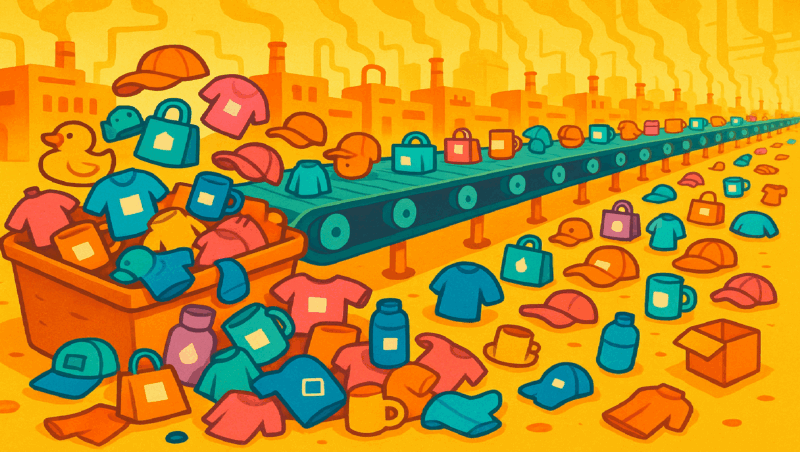
And yet, Disney is still printing money. That’s when everything clicked — Disney isn’t an entertainment or theme park company. It’s a merchandising company, and it’s exceptionally good at it. I started studying Disney’s billion-dollar merchandising engine. Five key marketing lessons emerged that marketers should take note of.
Lesson 1: Emotional real estate > physical real estate
It’s easy to obsess over real estate — ad slots, endcaps at Target, SEO rank. I’ve even seen fixation over the real estate of an office manager’s desk. Disney doesn’t play that game. It focuses on emotional real estate, understanding that while physical placement is temporary, emotional attachment lasts.
If you own emotional real estate, customers seek you out. If you don’t, you’re forced to fight with thousands of other marketers to shove your product in front of them and hope it interests them enough to buy. That’s why grown men proudly wear Baby Yoda hoodies, why parents buy their kids Marvel superhero backpacks without a second thought and why Disney merch doesn’t need awareness campaigns. People go looking for it.
That’s emotional gravity. Disney didn’t create most of the franchises it owns, but it exploits that pull better than anyone else. Most companies never even attempt to build it.
Dig deeper: How to prove the value of brand marketing without sacrificing ROI
Lesson 2: Build on other people’s IP and platforms
Disney’s real marketing genius is piggybacking on emotional real estate others already built, then amplifying and monetizing it. Marvel, Pixar and Star Wars were all created by someone else. Disney bought them, plugged them into its machine and licensed them aggressively. LEGO, Funko, Loungefly, Crocs, Build-A-Bear and Daniels Jewelers all market Disney — and pay for the privilege. Even YouTubers reviewing these collaborations promote Disney for free.
Many teams fall into hero mode. If they don’t get credit for the heavy lifting, the opportunity loses appeal. Disney plays a different game. Credit does not matter. Reach does. Licensing and partnerships extend reach far beyond what most budgets can achieve. They are not a brand dilution. They are a growth accelerator.
Instead of building every audience from scratch, borrow audiences at scale. Used well, collaborations become force multipliers that grow relevance faster than your budget ever could.
Lesson 3: Minimize risk by maximizing familiarity
Disney rarely asks customers to understand something new. Its products are familiar and easy to categorize. That’s why Disney merchandise often sells before anyone has even seen the movie.
The opposite approach is common in marketing — pitching revolutionary or paradigm-shifting products that consumers cannot immediately place. Humans choose the option that feels safest — and safe almost always means familiar. If a customer has to think too hard to understand how something improves their life, the sale is already lost.
Use familiarity to position products and services within categories the brain already trusts. Introduce what’s new only after that comfort is established. When an audience can instantly imagine what something is, what job it does and how it fits into their world, the sale becomes 10 times easier.
Dig deeper: How to measure the impact of brand marketing
Lesson 4: Ubiquity isn’t desirability
Disney IP appears on almost everything — shirts, cereal boxes, fruit snacks, Lunchables, Crocs, paper towels and wireless chargers. If it has a flat surface, someone has likely put Baby Yoda on it.
Disney assumed that being everywhere would lock in culture — and customers’ wallets — forever. That is not what happened. Overexposure cheapened its brands, turning them into background noise. Instead of looking desirable, Disney began to look desperate.
Some marketers fall into the same trap. They confuse visibility with value and assume repetition equals persuasion. It does not. Customers do not buy something because it is everywhere. They buy because it solves a meaningful problem at the moment they are trying to solve it.
That’s why the most effective strategies focus on a few critical evaluation moments, not total saturation. Relevance comes from demonstrating a deeper understanding of the problem and its solutions than can be found elsewhere. That kind of value bypasses the noise filter and lands in the “pay attention” category.
Lesson 5: Forget the customer, lose big
A merchandising engine needs fuel, and passionate fandoms are premium-grade gasoline. That is why Disney acquires IP with built-in fans, such as Marvel and Star Wars, and monetizes it aggressively. But this strategy has a fatal flaw. It turns customers into a revenue source and quickly exhausts their trust — which is what made them valuable in the first place. Disney does this repeatedly.
When Star Wars fans pushed back on story decisions, continuity or creative direction, Disney did not say, “We hear you. We’re fixing it.” Instead, it told the fans who camped out for opening night and bought the merchandise, “You’re the problem.” That response seriously damaged trust and goodwill. Disney then appeared surprised when those same customers stopped showing up.
The most important lesson to learn from Disney is that no brand is too big to destroy its customer base. When you chase new audiences instead of serving existing ones, loyal customers eventually move on — and take everyone they influence with them.
Dig deeper: A short guide to the long game of brand building
Pay attention to ‘The House of Mouse’
Disney is not the company most people think it is. In recent years, box office failures, flatlining park attendance and shrinking Disney+ subscriptions have put real pressure on the business. Yet the merchandising engine still works — and it offers clear marketing takeaways.
Across these five lessons, a pattern emerges:
- Emotional real estate beats ad real estate.
- Borrowing platforms is more effective than building from scratch.
- Familiarity outperforms forced novelty.
- Relevance matters more than omnipresence.
- Sustained success depends on keeping current customers front and center.
Disney succeeds when it follows these principles and stumbles when it ignores them. Marketers are no different. The moment attention drifts from what customers value, expect and instinctively reject, the same slow erosion begins.
Dig deeper: CFOs want hard numbers, not brand vibes
Fuel up with free marketing insights.
Contributing authors are invited to create content for MarTech and are chosen for their expertise and contribution to the martech community. Our contributors work under the oversight of the editorial staff and contributions are checked for quality and relevance to our readers. MarTech is owned by Semrush. Contributor was not asked to make any direct or indirect mentions of Semrush. The opinions they express are their own.